

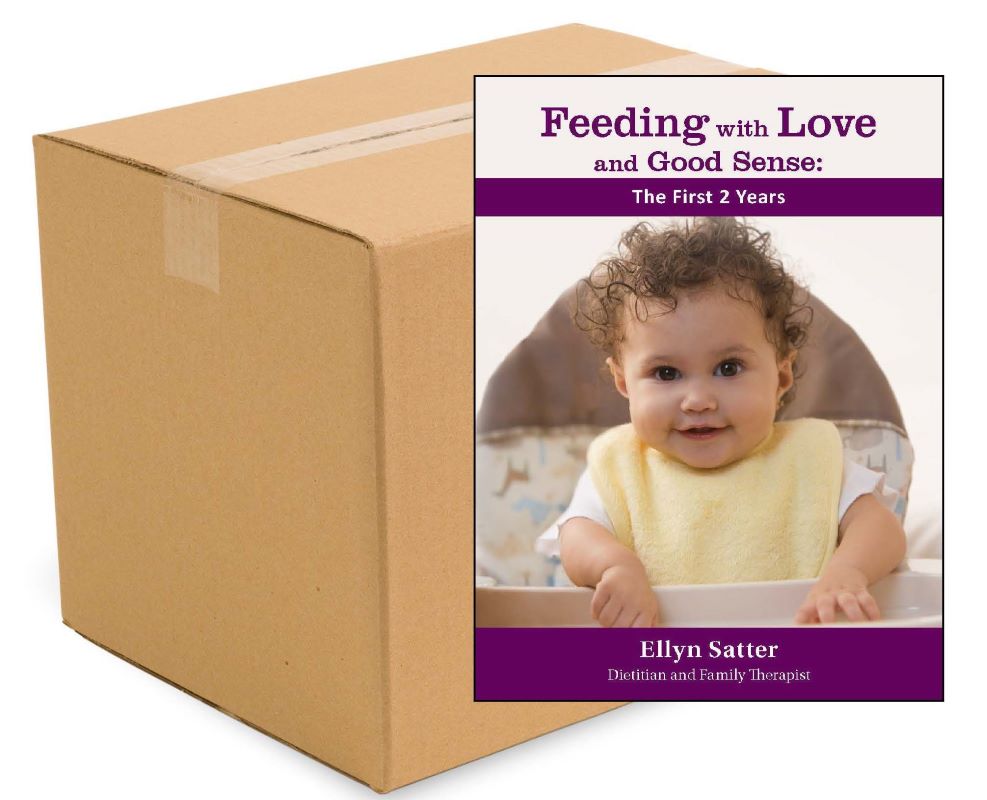
Feeding with Love and Good Sense: The First Two Years
Price range: $0.00 through $840.00
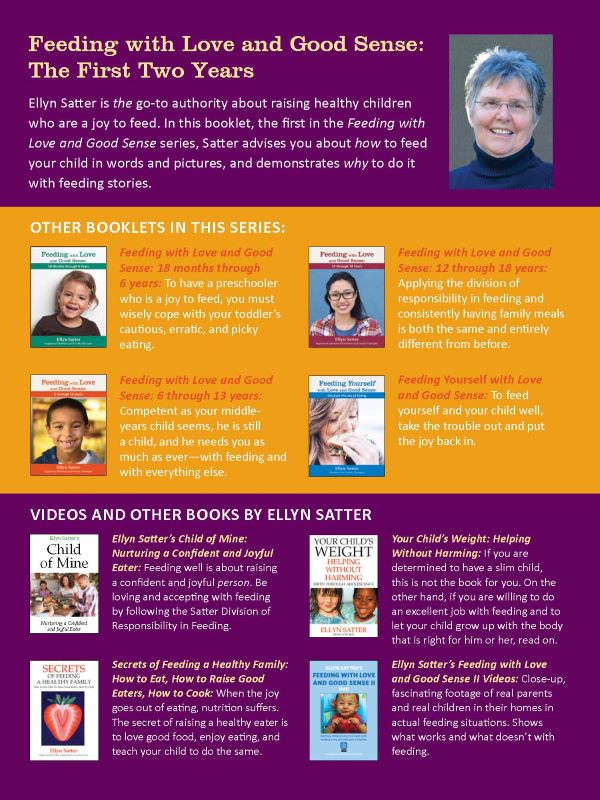
Ellyn Satter is the go-to authority about raising healthy children who are a joy to feed. In this booklet, the first in the Feeding with Love and Good Sense series, Satter advises you, in words and pictures, how to feed your child, and demonstrates why to do it with feeding stories.
Feeding with Love and Good Sense: The first two years is appropriate for medical and educational settings, health care, public health, mental health, and public service.
Use this booklet to support your practice! Explore the quantity discount schedule! Have particular needs? Contact us at [email protected].
Contents
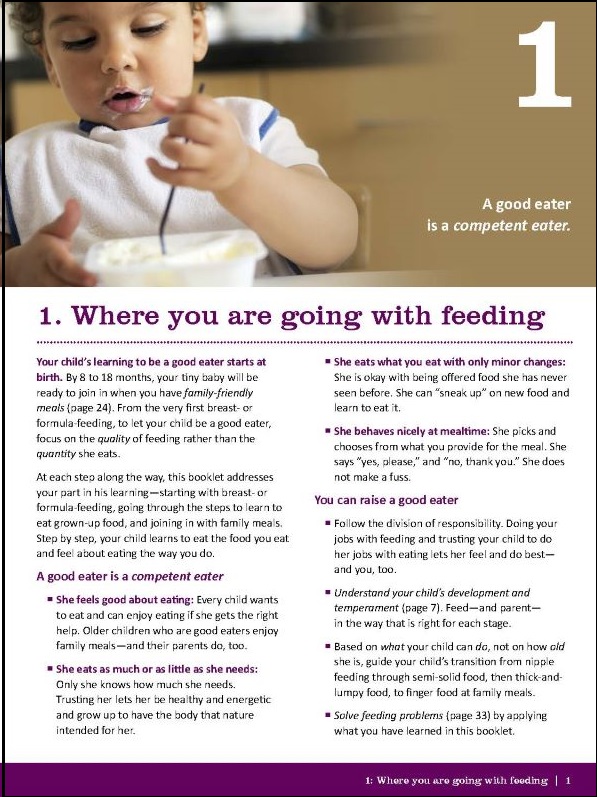
- Where you are going with feeding. Think of your child as a future toddler. By 8 to 18 months, your tiny baby will be a good eater and ready to join in when you have family-friendly meals.
- Follow the division of responsibility. To raise a good eater, do your jobs with feeding and parenting, then trust your child to do her jobs with eating, moving, and growing.
- Understand your child’s development and temperament. Being able to recognize stages in development and understand temperament lets you trust and enjoy your child and parent in the best way.
- How to feed your newborn and infant. Your baby eats best and feels best about you—and about eating—when you pay attention to her and do what she wants.
- How to feed your older baby and toddler. Start and progress solid foods based on what your baby can do, not how old he is. Rules about when and what to feed make you ignore your baby and doubt your judgment.
- What to feed your child: step by step. Your child might progress from starting solids to joining in with family meals in a couple of months, or it may take a year or more. Go as fast or as slowly as is right for her.
- Solve feeding problems. To correct feeding problems, be sure to do your jobs and just as sure to refrain from trying to do your child’s jobs. Focus on the quality of feeding rather than the quantity your child eats.
- What you have learned. Feeding is parenting in all ways. You have to do your jobs, but then you have to let go. Throughout the growing-up years, maintain a division of responsibility in feeding.
Get off to a good start with feeding
Your baby was born with a longing to be understood. When you feed the way they want they feel loved and respected. Get on your baby’s wavelength by learning to read their sleep rhythms and signs that tell you when, how much, and in what way they want to eat. As your baby gets older, this brief, beautiful, and entertaining booklet gives you solid and practical advice about when and how to start solid food, navigate the transition to family food, and stay out of feeding skirmishes with your toddler, and enjoy family meals. Appropriate for eating dysfunction and disorder prevention and treatment in medical and educational settings, health care, public health, mental health, and public service.
Table of Contents
- Where you are going with feeding. Think of your child as a future toddler. By 8 to 18 months, your tiny baby will be a good eater and ready to join in when you have family-friendly meals.
- Follow the division of responsibility. To raise a good eater, do your jobs with feeding and parenting, then trust your child to do her jobs with eating, moving, and growing.
- Understand your child’s development and temperament. Being able to recognize stages in development and understand temperament lets you trust and enjoy your child and parent in the best way.
- How to feed your newborn and infant. Your baby eats best and feels best about you—and about eating—when you pay attention to her and do what she wants.
- How to feed your older baby and toddler. Start and progress solid foods based on what your baby can do, not how old he is. Rules about when and what to feed make you ignore your baby and doubt your judgment.
- What to feed your child: step by step. Your child might progress from starting solids to joining in with family meals in a couple of months, or it may take a year or more. Go as fast or as slowly as is right for her.
- Solve feeding problems. To correct feeding problems, be sure to do your jobs and just as sure to refrain from trying to do your child’s jobs. Focus on the quality of feeding rather than the quantity your child eats.
- What you have learned. Feeding is parenting in all ways. You have to do your jobs, but then you have to let go. Throughout the growing-up years, maintain a division of responsibility in feeding.
- Free first chapter!
- 2025 copyright
- 6th grade reading level
- 40 pages, 7.5 by 11 inches
- Full color, photos
1 review for Feeding with Love and Good Sense: The First Two Years
Related products
-
Sale
NEW Child Feeding Package – 2 Booklet Hardcopy
Original price was: $44.95.$40.00Current price is: $40.00. -
Ellyn Satter’s Child of Mine: Nurturing a Confident and Joyful Eater
Price range: $0.00 through $280.00 -
Feeding with Love and Good Sense: 18 Months through 6 Years
Price range: $0.00 through $840.00 -
Your Child’s Weight: Helping Without Harming
Price range: $0.00 through $384.00 -
Family Meals Package
$37.00
Julie Drzewiecki –
Best Infant Feeding Book In The World
As a Registered Dietitian who provides nutrition counseling to pregnant women with gestational diabetes and to parents of babies and children, I am here to testify this is the best infant feeding book. I nagged my boss incessantly until he let me provide copies to my patients. My patients LOVE this resource. The OB/GYN’s I work with LOVE this resource for their patients. My boss now realizes that provided these books to our patients was a great public relations coupe for our hospital. Don’t wait! Buy your copy today!