

Learn about fdSatter
Original research
- Eating Competence: Definition and evidence for the Satter Eating Competence Model
- Measuring eating competence: psychometric properties and validity of the ecSatter Inventory
- Reliability of the ecSatter Inventory as a tool to measure eating competence
- Associations between eating competence and cardiovascular disease biomarkers
- Hierarchy of Food Needs
- Eating Competence: Nutrition Education with the Satter Eating Competence Model
Understanding ecSatter
- ecSI 2.0
- Eating competence
- Eating competence: Eating attitudes
- Eating competence: food acceptance
- Eating competence: internal regulation
- Eating competence: Context-management skills
- Eating competence: putting it all together
- Counseling with ecSatter
- Counterfeit permission
- A taste of eating competence for those struggling with eating
- Eating competence and nutrition facts labels
- Eat what you like and be healthy! ecSatter accomplishes the Dietary Guidelines
Applying ecSatter
Satter Approach To Eating
by Ellyn Satter
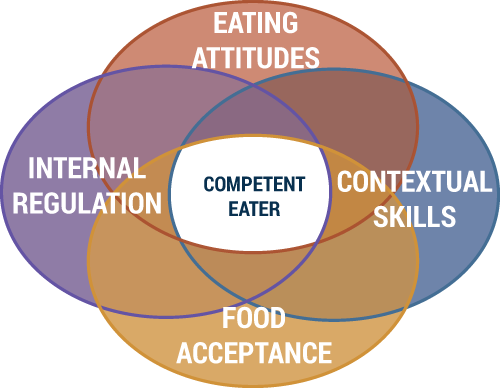 I created the Satter Eating Competence Model because I was doing harm by putting people on diets. After years of trying, I have discovered that healthy eating is about the joy of seeking and eating food, not about restricting and avoiding it. The evidence supports that discovery. Subsequent testing all over the world with translated versions of ecSI 2.0 has shown that even though ecSatter says nothing at all about what or how much to eat or what to weigh, people who are Eating Competent (EatC) eat better and have a better quality of life, have the same or lower BMIs, and have superior wellness indicators. Find references here.
Let me tell you how I got there.
The weight loss dream
As a young dietitian in my outpatient practice, I knew the data: 5% of people lose weight and keep it off. But it would be different for me! I had my nifty diets, and I could motivate and do follow-up. So I and my unfortunate patients struggled with weight: The man who lost 100 pounds and gained it right back; The many who stopped coming and blamed themselves for failing; The ones for whom I had nothing more to offer who became dependent on me for weight management; The two (2) who lost weight and kept it off. The last two were both virgin dieters who started out inactive and eating a lot. Clinicians in professional journals reported producing weight loss. Why couldn’t I? I must do more, harder! I realized too late that the literature lies: by cherry-picking results, presenting distorted statistics, and giving short-term results. GLP medications do more, harder, and they too will fail: The lesson I learned decades ago will be relearned by todays practitioners and weight-loss seekers. But back to my story.
The behavioral weight control fiasco
 So I did more, harder, and it was a doozy. I trained with a then-leading expert in the then-popular behavioral weight method, and I was transformed. I was charismatic; for 20 weeks I inspired a group of dedicated and tolerant people who deserved far better than they got. Those lovely folks did everything I asked: recorded eating times, feelings, and circumstances; counted calories; put their forks down between bites; ate only sitting down, in a certain place, with no associated activities; exercised vigorously; and, of course, recorded and graphed it all. There was more, but memory (mercifully) fails me. They lost weight in gobs.
Creating dietary cripples
Thank goodness for follow-up. One month – one month – after the end of the 20-week group, everyone came back heavier. My star couple. My man who was an obsessive dieter who lost weight for the first time in years. His helpful and supportive wife. Everyone. And they were so ashamed. I was young. I was shocked. I was speechless. I so wish I had said to them, “What have I done to you?” The body does not want to let go of weight, and the pressure to regain is simply enormous. The same as my patients, regainers blame themselves and feel so much shame! Following that debacle, I saw others who had become dietary cripples at my hands: the patients with diabetes, the folks with heart disease, those with ulcers and high blood pressure.
Learning to ask questions
In disarray, I went back to graduate school to become a psychotherapist, where I learned not to give answers but to ask the questions I should have asked all along: How do you see that you get fed? How do you feel about eating that way? How were you fed when you were a child? What would you like to be different? It was scary at first to stop telling people what and how much to eat and simply encourage them to have meals and give themselves permission to eat what they wanted. They and I both feared that they would go out of control, but they didn’t. Unlike the folks on diets, their eating developed order and reliability. Gradually, the components of what later became the Satter Eating Competence Model (ecSatter) became apparent: positive attitudes, interest in food, ability to internally regulate how much they ate, and relaxed, regular meals and snacks.
Testing ecSatter
Since it was hard to measure our success, I wrote a test to measure eating-that-is-going-well. I tried it out with my patients, rewrote, and rewrote again. Enter professor and researcher Barbara Lohse, who asked, “does this stand up to testing?” She meant real, research-based testing. “I don’t know,” I said, “but I am game to see.” Over several years we tested the Satter Eating Competence Inventory (ecSI 2.0), and finally we had our answers. The test worked. Whew. People who scored high did better.1,2
ecSatter works
As I said to start with, ecSatter works. Explore the evidence, and discover the joy of eating.
Join our mission!
This last part of the story is about you. My colleagues and I hope you will use this website to discover the joy of eating—and feeding—following the Satter models.
- Poke around on the ESI website and see what you see. Read my books. Watch the videos. Get on our mailing list.
- Join our Facebook pages for the public and for professionals. Ask questions. Share your experience. Learn and grow.
- Consider whether you want to learn how to help without harming. Get in touch with us and share your ideas for how you could help reach out to other parents and professionals.
- Donate. ESI does a lot on a shoestring. We could do more if we had the money. Your donation is tax-deductible.
References
- Lohse B, Satter E, Horacek T. Measuring Eating Competence: psychometric properties and validity of the ecSatter Inventory. J Nutr Educ Behav. 2007;39:S154–S166.
- Krall JS, Lohse B. Validation of a measure of the Satter Eating Competence model with low-income females. Int J Behav Nutr Phys Act. 2011;8. doi:10.1186/1479-5868-8-26
Click to read the story of the Satter approach to feeding